After my first visit to APE in 2025, which I liked a lot, it only made sense to go again this year. And there was an additional reason to go when we received the invitation for the ‘startups to watch’ session, in the format of Shark’s Tank.
My trip didn’t start very well with a cancelled flight, but after rebooking I finally arrived, half a day later than expected. With APE 2026 being the first conference of the year, the start often seems like some kind of ‘happy new year’ reception, which is great for the atmosphere! It was great catching up after the Christmas holidays with so many partners, customers and friends. Because of the meetings I had, I wasn’t able to attend all the sessions, but the conversations that were sparked by the panel sessions were good. As always, a lot of talks about AI, but for some reason, it felt like we dove a bit more into the topic instead of superficially discussing AI. And that was a nice change of pace.
Next to talks and discussions about AI, there were also quite some keynotes and panels about academic freedom, and specifically about safeguarding research under political pressure. And where most would immediately point at what’s happening in the United States right now, things are also becoming less open and free in a lot of (western) European countries!
In relation to this, one of the panels about AI, started with a very impressive, powerful and emotional statement from Sahar Vahdati. Not a statement about AI, or even academic freedom, but a statement about how all of these things don’t really matter if there’s no freedom of speech and expression in a country like the country she was born in: Iran. Her call to action was, don’t be silent and speak up about these brutal human right violations in Iran. Full support from our side!
Back to the reality of the sessions, it was very clear that, although everyone is using AI, most of us are very careful in hooking it up directly to publishing systems. Especially in decision making roles. This was especially clear from the results that were presented at the pre-conference workshop on Monday, where a staggering 85% of participants voted for the option that AI should never be used in final accept/reject decisions. Relevant to us at Global Campus, is that 18% also voted against using AI for selecting/ranking peer reviewers. It might go without saying, when looking at these percentages, that people were allowed to vote on multiple AI use cases.
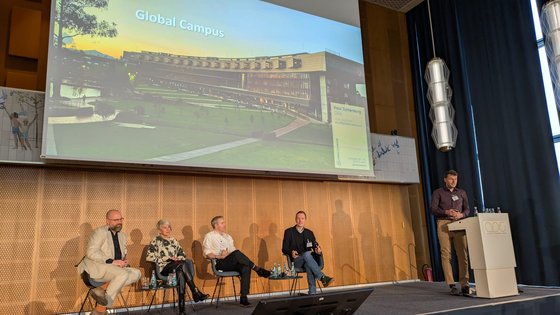
Last but not least, I want to highlight the ‘startups to watch’ session where I presented Global Campus, next to the pitches of Philipp Hess about Publishing Gateway and Laura Harvey on Pure.Science. Laura won the audience vote, so a huge congratulations to Pure.Science! I was happy to see that both the jury and the audience seemed to like the Global Campus proposition, which was emphasized by the number of people that reached out to me afterwards.
Thanks again to the organization of APE for hosting this event, the conference dinner, and for inviting me as one of the speakers. I had a few amazing days in Berlin this week!