Claiming your author profile in OpenAlex
Your papers exist. Your citations are real. But if you've never claimed your OpenAlex author profile, the world may be looking at a blurry, incomplete version of your scholarly record - and you might not even know it.
It takes just a few minutes to fix that. Here's why you should do it today.
What Is OpenAlex?
OpenAlex is the world's largest open catalogue of research — 477 million works, all freely accessible to anyone without a subscription. Named after the ancient Library of Alexandria, it launched in 2022 as the open successor to Microsoft Academic Graph and is run as a public good by the non-profit OurResearch.
This isn't a niche tool. OpenAlex now powers library discovery systems, funder dashboards, university rankings, and a growing wave of AI-driven research tools. When someone searches for your work — a hiring committee, a potential collaborator, a grant panel — there's a good chance OpenAlex is part of what they see.
The Problem: An Unclaimed Profile Is Just an Algorithm's Best Guess
Matching millions of papers to the right author is one of the hardest problems in bibliometrics. OpenAlex does it automatically, which means your unclaimed profile is an educated estimate — and estimates can be wrong.
The algorithm might split your work across several near-duplicate name variants, accidentally merge your record with another researcher's, miss papers you've published, or attach work that was never yours. Only a small fraction of researchers has linked an ORCID to help correct this. The result? Inaccurate metrics, a fragmented publication list, and a profile that doesn't reflect the work you've actually done.
Why Claiming Matters — For You and Everyone Else
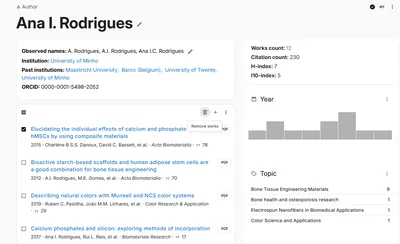
Claiming your profile gives you direct control. You can merge name variants, add missing papers, and remove work that isn't yours. Your publication count, h-index, and citations become accurate. Anyone who looks you up sees a complete, trustworthy picture.
But the impact doesn't stop with you. OpenAlex is a shared commons — the corrections you make flow into every tool built on top of it. Sector-wide analyses, institutional rankings, and discovery tools all get a little more reliable when each researcher takes a few minutes to clean up their own record. It's collective infrastructure, maintained collectively.
How to Claim Your Profile (It Takes Under 5 Minutes)
1) Find your page. Go to openalex.org and search your name. Your author page URL will look like: openalex.org/authors/a5058469610
2) Click "Claim." The button sits at the top-right of your author page. You'll need a free OpenAlex account to proceed.
3) Prove it's you. Paste a link to any public page — a department staff page or your ORCID record — that shows both your account email and your name on the profile.
4) Submit and wait. The badge switches to "Claim pending" while the team reviews it, usually within a few days. No need to resubmit.
Once verified, you can remove wrong name variants, delete misattributed papers, bulk-clear several at once, and add missing works by DOI. Link your ORCID and new publications will flow in automatically going forward.
Open Doesn't Mean Effortless
"Open" describes the license, not the cost of running the platform. Keeping 477 million works accurate and freely available takes real engineering and sustained funding. OpenAlex depends on organizations — like Global Campus — choosing to invest in the commons they rely on, rather than paying subscription fees to closed competitors.
Your profile claim is the smallest possible contribution to that commons — but multiply it across thousands of researchers, and you get something remarkable: an open, accurate map of global scholarship, maintained by the people who created it.
Go to openalex.org and claim your profile today.