Call matching in Global Campus
Every new work programme brings the same question for researchers and research offices: which of these calls fit our work? Answering it usually means reading through long lists of call topics, one researcher at a time, and hoping nothing relevant slips past.
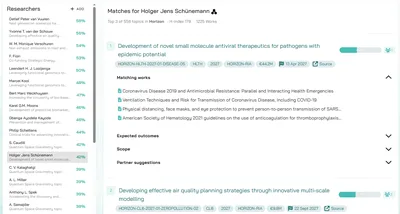
Call matching in Global Campus turns that question around. Instead of starting from the calls, it starts from the researcher. Based on their publications, Global Campus shows the funding call topics where their work is the strongest match, for draft and published work programmes such as Horizon Europe and the European Defence Fund (EDF).
Call matching also suggests potential consortium partners, and the experts to contact at a relevant institution.
How the matching works
Call matching builds on a researcher’s OpenAlex profile, which can be found through their ORCID iD or their name. Global Campus then compares the meaning of their publications with the text of each call topic. Because the comparison looks at meaning rather than exact keywords, it also finds calls that describe a researcher’s field in different words. That makes it especially useful for interdisciplinary research, where the right call is often phrased differently from the work it fits.
Call matching covers draft as well as published work programmes. Researchers and research offices can therefore start exploring opportunities before a programme is final, and have more time to prepare.
Everything you need to judge a call, in one place
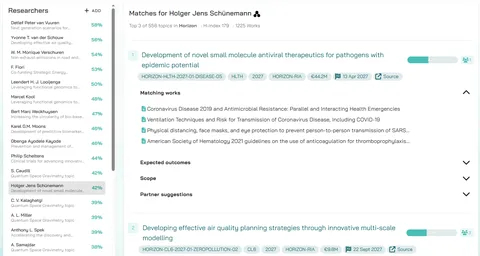
For each researcher, call matching returns a ranked list of call topics, each with a match score. Alongside the score, every call shows some call details: the call identifier, cluster, year, type of action, budget and deadline, with a link to the original call text.
Each call lists the researcher’s publications behind the match, so it is easy to see why a call was suggested. A summary of the expected outcomes and scope shows what the call is looking for, without having to open the full work programme.
The results can be narrowed to what is realistic, for example by deadline, cluster, programme, single- or two-stage calls, type of action, or specific terms in the call text. Promising calls can be saved, or exported to share with colleagues.
From the right call to the right partners
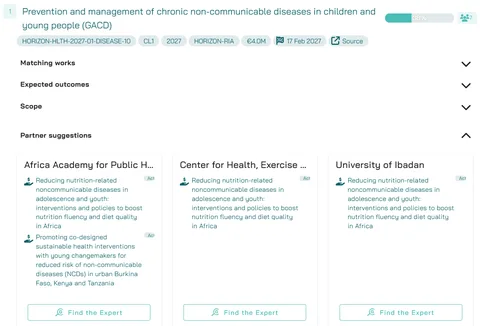
Many calls ask for a consortium, and finding the right partners is often one of the hardest parts of a proposal. That is why call matching also suggests potential partners for each call: institutions that have been involved in funded projects on closely related topics. The relevant projects are listed with each institution, so it is clear why it might be a good fit.
Call matching then connects directly to Global Campus’s expert search. For any suggested partner, Global Campus identifies the researchers at that institution whose work best matches the call, with their publications, profiles and, in most cases, contact details.
Potential connections can be checked, profiles compared and the most promising experts saved for later. In a few steps, a research office goes from a call that fits to the people a proposal could be built with.
Who is it for?
Call matching is built for anyone who connects research to funding:
- Researchers who want to see which open and upcoming calls fit their own work.
- Research offices and grant advisors who support many researchers and need a reliable first selection of calls for each of them.
- Consortium builders looking for institutions and experts with a track record on the call's topic.
Want to see which calls match your researchers? Get in touch at support@globalcampus.ai for a demo.