Forget keywords, focus on understanding.
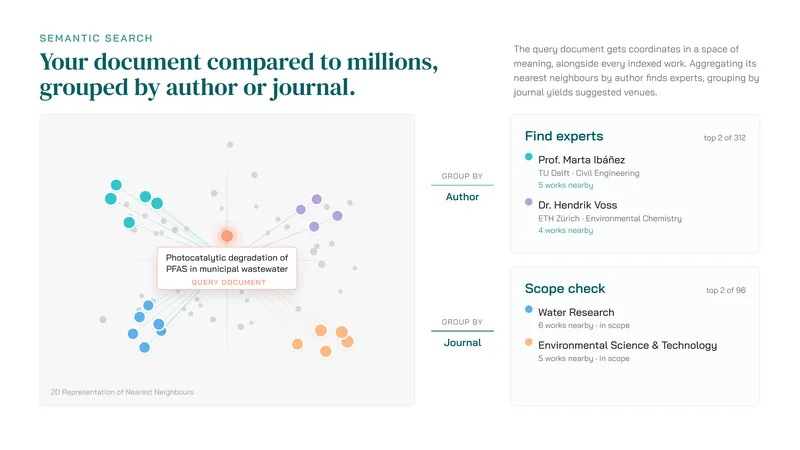
Semantic Space
The meaning of an input is interpreted and placed in a semantic space, where other similar documents are close.
Finding Experts
Group the top publications by their co-authors to find experts who have published similar work.
Journal fit
Find out which venues have published similar work, for instance among a particular publishers portfolio.
What is Semantic Search?
Traditional search approaches use keywords to find what you are looking for. But keywords are imperfect things: some concepts are known by multiple words, and some words mean more than one thing.
This is why there's room for improvement with Semantic Search: it uses Artificial Intelligence models that capture the meaning of sentences in so called vectors - transforming text into numbers that you could think of as coordinates in a space of meaning.
Close means similar
The models Global Campus uses are trained to place documents with similar semantic content close to one another. Documents with a different meaning (even if the words are alike very much the same) end up in a different place.
Used on multiple corpora
Global Campus applies semantic search on different datasets such as publications and research projects from OpenAlex, Funding Opportunities from the European Commission or more broadly through our partnership with ResearchConnect. Some clients bring their own document sets in a private environment for semantic matching and aggregation.